Awning technology has advanced over the past decade, and retractable awnings have become mainstays in British gardens. Not the flimsy, cheap versions that used to be commonplace, but awnings designed to extend your liveable outdoor space. With retractable awnings priced from a few hundred to several thousand pounds, understanding how to separate a good investment from an expensive mistake is, of course, quite difficult.
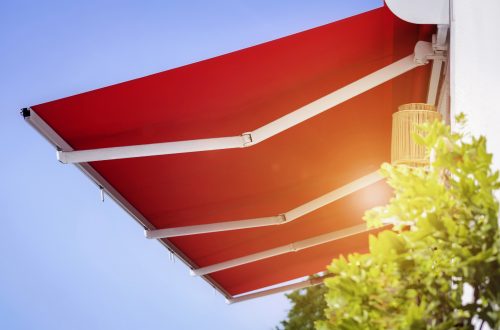
Let’s cover the basics. A retractable awning is a weather resistant fabric that is attached to your home, and that fabric extends horizontally to provide you and your guests with shade and protection from the rain. Awnings can be extended and retracted either manually with a hand crank, or using an electric motor. Simple, but the quality engineered awnings are designed and manufactured with great attention to detail, and the good ones are the subject of relevant patent applications.
Manufacturers of cheap awnings are literally cutting corners. It is the retractable awning’s mechanical component that, in cheap awnings, fails—sometimes rather spectacularly. The good quality retractable awnings use gas springs and structures made of aerospace grade aluminium. Cheap metallic awnings use thin walled components that bend in the first wind. A retractable awning’s tension system is made to hold several metres of thin fabric taut, and to withstand wind. It is in the tension system that the corners being cut in a cheap retractable awning are more obvious.
Choosing the right materials is crucial for making long-lasting and reliable awnings. Many awning manufacturers use solution-dyed acrylic as the awning materials as they have the ability to last many summers without fading in colour. These fabrics even last in the damp mouldy conditions as they literally prevent the growth unlike “water resistant” fabrics which will dry after getting soaked. Many competing tile fabrics use low quality polyester so even if they look pretty in the show room, they will degrade after being exposed to sunlight as the poly for tile will degrade quite quickly.
Now, moving on to the installation considerations, if an awning is improperly mounted, it will be less than par. Mounting is so crucial that on the walls, depending on the materials used, mounting can be done using wood, metal, or even brick as they will function as sails going in the airflow. Because of this, they need to be mounted properly. If whoever’s fitting it doesn’t know the difference between fixing into mortar versus brick, or doesn’t use the right fixings for your particular wall type, you’re asking for trouble.
When comparing businesses, don’t only consider their price. How long have they been in business? Do they have pictures of installations from 5 years ago that are still in good condition? A quality company will do site inspections instead of giving estimates over the phone, because every job is different. They will ask about your walls, the angle of the walls to ensure proper drainage, and which way the walls face because they will explain the best way to position the walls.
When the company provides guarantees, that says a lot about them. A good company will have 10 year guarantees on the material and 15 years on the frames, so if they are only giving a 2 year guarantee, that is likely the lifespan they are expecting on the installation. Furthermore, check who is providing guarantees on the work. Some companies will guarantee the covers of the awning while not guaranteeing the installation.
It is common to wonder whether it is better to choose a local or a national company. Local companies will have a vested interest in the community and are more likely to return to make adjustments. With a national chain, their customer service will be dependent on the coverage of the net. Local companies are more likely to integrate quality work with customer service. You can check the completed work of a local business prior to hiring them, which is not the case for national companies.
We’re talking about bringing it in during storms (even the expensive ones have limits), cleaning the fabric annually with mild soap rather than pressure washers, and getting the mechanism serviced every few years. A good installer will explain this upfront rather than assuming you’ll figure it out. Installing quality retractable awnings is an investment in your future, with an expected lifespan of about fifteen to twenty years (ideally upwards of twenty), and more than a hundred additional days of usable outdoor space each summer.
Don’t get baited and switch to a cheap awning vs more expensive one, because you’ll pull your costing right out of your awning (retracted or retracted). The cheap models are hidden money traps that will need to be serviced or replaced in the time it takes for the better models to be worth it.
Title of the class and focus your research efforts. It’s a sign of quality to see a busy showroom floor. Quality companies will be happy to chat about their history of ups and downs, as well as answer all your questions, whether they’re hard or appear to be.